



The Rise of Semi-Autonomous Grading: Cat Graders for Sale in Industry
Cat motor grader for sale in the market, does it fit in the future with the rise of semi-autonomous machines in the industry?

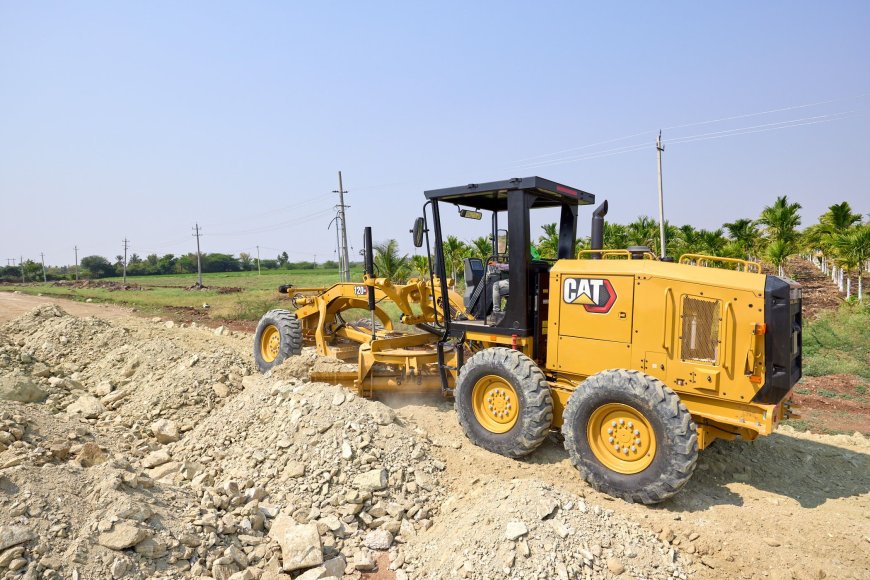
Construction is on the verge of a new age of productivity, and automation is no longer a buzzword but a daily reality that is transforming job sites worldwide.
Maybe the most powerful technology to hit the scene is semi-autonomous grading, a union of precision technology and human ingenuity.
Caterpillar, the firm that has been pushing heavy equipment technology to the leading edge, has put its graders at the epicenter of this revolution.
For contractors in the market for buying Cat graders, the conversation today is no longer horsepower and blade width. It's advanced grading systems, productivity, and future-proofing your fleet.
From Manual Operation to Smart Assistance
The conventional graders are operator-dependent in terms of ensuring the grade is accurate. Although the experienced operators can achieve very good results, the process is not only labor-intensive but also time-consuming.
In comes semi-autonomous grading. The machines that Caterpillar manufactures now assist the operator in real-time by automating most of the small adjustments through the use of integrated technologies. Such as Grade Control and Assist functions.
Such systems assist in keeping blades at a standard angle, adhering to pre-determined designs, and prone overcutting or undercutting.
Semi-autonomous assistance does not make the operator obsolete, but rather gives them strength.
The support of intelligent controls can help less experienced crew members produce results that border on expert levels.
To the contractors who invest in Cat graders for sale, this implies that they will be able to improve the accuracy of grading at all levels, even though senior operators are scarce.
Efficiency with Precision Automation
The ability to finish assignments more quickly without sacrificing accuracy is one of the main benefits of semi-autonomous grading.
Scalable solutions like Cat Grade with Auto Articulation, Cat Grade with 3D, and Cat Grade with Cross Slope are now included with Cat motor graders.
These systems drastically cut down on rework in addition to guaranteeing that work is done according to specifications the first time.
There is a significant effect on project timelines. Grading tasks that previously needed numerous passes and ongoing adjustments can now be finished more quickly and with fewer inputs.
These time savings result in fewer man-hours, less fuel consumption, and more predictable jobsite results for fleet owners and project managers assessing Cat graders for sale.
Tackling Labor Shortages with Operator-Friendly Innovation
The construction sector is facing a problem of labor shortage, especially in skilled heavy equipment operators.
The solution is semi-autonomous graders that offer a decreasing learning curve and simplify complicated tasks.
Machine-guided steering and blade control mean that new operators are able to take on grading tasks that would have taken years of experience in the past.
The user interfaces and real-time feedback systems of Caterpillar also help the development of the operators.
The Cat 140 and Cat 150 motor graders are machines that have increased visibility, joystick steering, and settings that can be individually adjusted to suit different operators.
Such a human-centric design philosophy guarantees that technology will serve to augment the role of an operator and will not complicate it.
In the process of seeking Cat graders to purchase, the potential to provide new members of the team with modern tools becomes a high-value strategic advantage in hiring and retention.
Connectivity and Remote Management
One important aspect influencing semi-autonomous grading implementation is integrating telematics with remote monitoring technologies.
Caterpillar's VisionLink system enables managers to track various parameters. Including equipment performance, fuel usage, grading progress, and location.
Such connectivity optimizes fleet utilization and allows proactive maintenance, thereby minimizing instances of unplanned downtime.
Data gathered from sensors mounted on the machine can be used for blade optimization, operator training, and optimizing the pattern of grading.
To customers considering purchasing Cat graders, this digital platform equates to not just purchasing a machine, but an intelligent asset that drives continuous improvement.
Semi-Autonomy Without Losing Flexibility
Although complete autonomy could be the end goal of certain construction industries, the majority of jobs still need human judgment.
This is why the idea of the semi-autonomous grading that is offered by Caterpillar is so practical; it will not bind the machine into the framework of a strict automated system, but will be able to increase the capabilities of a human in their job. The operators stay in the loop and can override or adjust actions.
Its note should be taken by buyers who are focused on flexibility in their fleet. When purchasing Cat graders for sale with semi-autonomous technology, it does not imply that one has to forego manual operation; it only implies that he or she has a choice when it is most important.
Conclusion
Semi-autonomous grading is already changing how work is done today; it is no longer a vision of the future.
This change is being spearheaded by Caterpillar's motor graders, which feature sophisticated control systems and improvements aimed at the operator.
Selecting a machine with semi-autonomous features is important for buyers considering Cat graders for sale because it's not just about staying up to date; it's also about staying ahead of the curve.
In a field where accuracy, output, and people are all important, Cat's method of intelligent grading has a noticeable impact right from the start.